Navigating the Holistic Global Energy Landscape
Author: Luluk Sumiarso — Initiator of Trialism ©Energipedia
Abstract
This article introduces ©Trialism Energipedia, a living framework that treats energy not merely as a commodity but as a human–technical ecosystem composed of three mutually reinforcing dimensions: E1 – Physical Systems & Technology, E2 – Governance & Regulation, and E3 – Public Values, Purpose & Justice. Unlike conventional mappings of the global energy landscape that emphasize only technical structures and market design (E1–E2), Trialism operationalizes the often-missing ethical and societal layer (E3) as a first-class design variable. Methodologically, the framework enables systemic, modular, ethical, and reflective policy design through: (i) tri-layer tariff architectures that align cost recovery with protection for vulnerable consumers; (ii) “sequenced and safeguarded” transition roadmaps that are grid-ready, financeable, and socially legitimate; (iii) holistic infrastructure appraisal using multi-criteria decision analysis across E1–E2–E3; and (iv) resilient system architectures that are interoperable and evolvable. A natural-monopoly case (electricity networks) illustrates how Trialism balances TOTEX efficiency and reliability (E1), performance-based regulation and open access (E2), and universal service with just-transition instruments (E3). The result is a policy language that is replicable, auditable, and inheritable—capable of crossing jurisdictions and generations while remaining sensitive to local contexts in developing economies. With this philosophy, we extend the conventional Global Energy Landscape into a Holistic Global Energy Landscape that explicitly integrates purpose and justice into technical and regulatory choice.
Keywords: Trialism Energipedia; Holistic Global Energy Landscape; energy governance; just transition; performance-based regulation; modular policy design; natural monopoly; systemic resilience.
Opening Poem — “The Guiding Flame”
Amid cables, pipes, and spreadsheets
beats a pulse no table can contain:
the human will to live more justly.
Behind turbines, panels, and deep wells
rises a question graphs cannot grasp:
for whom do we deliver energy?
If machines are the body, and rules the soul,
then conscience is the breath—
the breath that guides the flame toward meaning.
1. Introduction
The energy world is moving across an increasingly complex chessboard. A rapid low-carbon transition races against a worsening climate crisis. Meanwhile, inequality in access—rolling blackouts here, biomass-dependent kitchens there—continues to fracture lived realities. Governance is often fragmented by institutional silos and short horizons, leaving policy to “fire-fighting” rather than orchestration.
International mappings of the Global Energy Landscape—from market and technology observers to economic forums and climate panels—have provided rich metrics. Yet most maps rest on two planes: E1 (physical systems and technology) and E2 (governance, regulation, market design). Necessary, but not sufficient: energy is ultimately a relationship among people, ecosystems, and values—alive and meaningful because public purpose exists. ©Trialism Energipedia therefore proposes a three-dimensional, living framework that explicitly adds the ethical–societal layer (E3) and, by doing so, extends the conventional Global Energy Landscape into a Holistic Energy Landscape—indeed, a Holistic Global Energy Landscape.
• E1 — Physical Systems & Technology: resources, conversion, grids, end-use devices, efficiency, reliability, safety.
• E2 — Governance & Regulation: policy, standards, incentives, market rules, tariffs, permitting, consumer protection, finance.
• E3 — Public Values, Purpose & Justice: intergenerational fairness, universal access, ecological limits, participation, cultural preferences, and the meaning of use.
With Trialism, energy is not only what we use, but how and why we use it. Conservation is not merely economic calculus—it is an ethical choice to lighten ecological burdens and enable fairness. Energy transition is not only system change; it is a transformation of consciousness from extraction to stewardship.
Why a holistic approach?
- Technical complexity never stands alone. Decisions on generation mix, smart grids, EVs, or green hydrogen reflect rules, institutions, and incentives (E2). Without alignment in E2, E1 stumbles in implementation.
- Policy without values loses direction. Tariffs, subsidies, and just-transition instruments need an E3 compass to balance security, affordability, and sustainability.
- Values without systems lack traction. Aspirations for justice, inclusion, and circularity must be translated into E1 designs and E2 instruments. E3 sets direction; E1–E2 deliver motion.
Trialism is therefore a living compass—adaptive to data, technology, markets, and civic aspirations; a three-realm configuration that evaluates feasibility (E1), legitimacy and investability (E2), and resonance with public values (E3); and a linking language that enables engineers, economists, regulators, and communities to collaborate.
We thus extend the usual map into a Holistic Global Energy Landscape—where technical and regulatory choices explicitly integrate purpose and justice.
2. The “Missing Layer”: An Intellectual Lineage
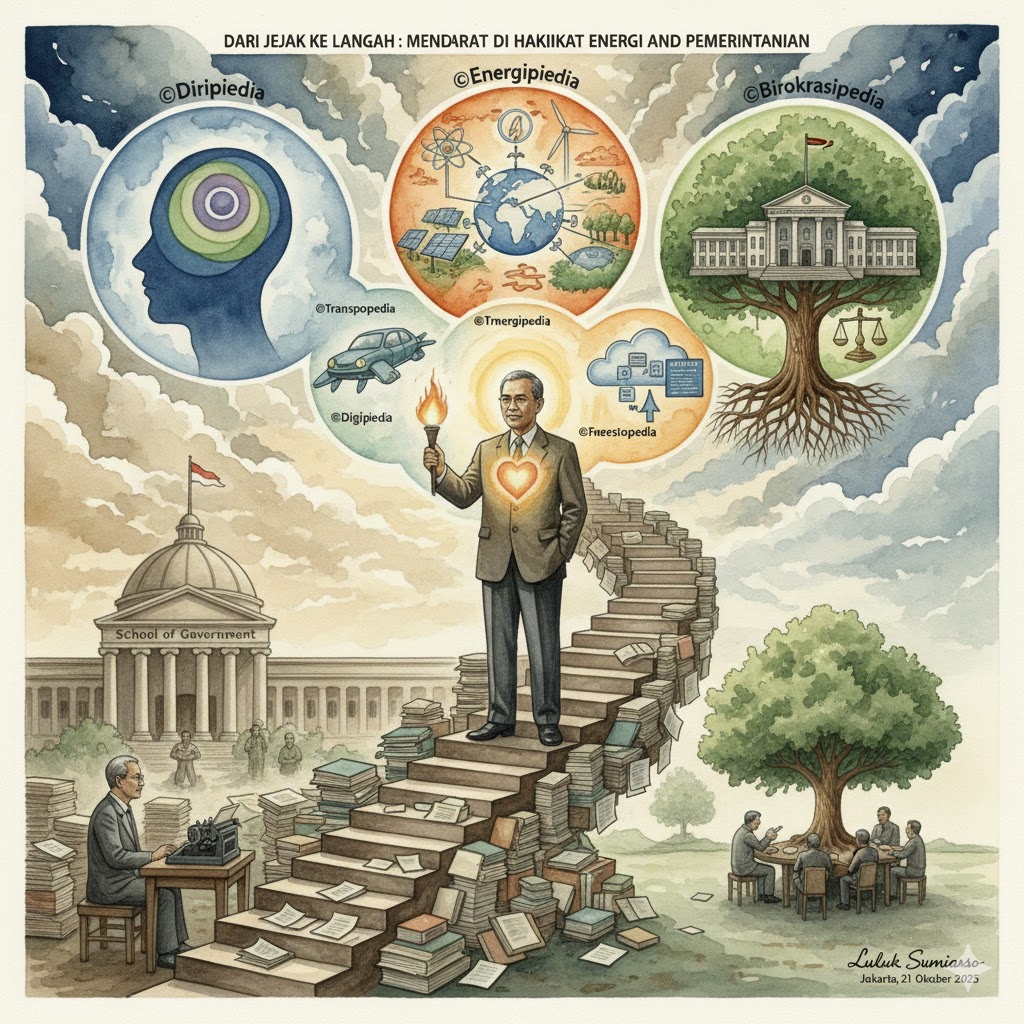
Long before “energy transition” became a global idiom, Indonesian energy thinkers seeded what we would today call E3. In the late 1970s, Prof. Sumitro Djojohadikusumo, Prof. M.T. Zen, and Prof. Subroto articulated a horizon where technical rationality and regulatory design were guided by wisdom—a term signaling that energy policy must be rooted in ethics, justice, and human–nature balance.
- Sumitro urged a National Energy Wisdom: energy as a nerve of development that must be fair, resilient, and long-minded—an early expression of E3 as compass.
- Subroto translated this into the General Wisdom of Energy Policy (KUBE), knitting E1 and E2 into a coherent platform oriented to public benefit—animated, implicitly, by E3.
- T. Zen called called for a philosophy of energy to complement policy practice; this call, however, was not elaborated into an explicit, systematic framework at the time.
- for an explicit philosophy of energy, anticipating Trialism’s argument that E1 and E2 require an ethical foundation to avoid drifting with narrow interests.
Two decades later, Prof. Purnomo Yusgiantoro strengthened the E2 realm through legal, institutional, and planning instruments.
In 2025, I formalized this ethical layer through ©Trialism Energipedia, making E3—public values, purpose, and justice—a first-class design variable alongside E1 and E2. In this operational language:
- E1 asks what we build and how it works;
- E2 asks how we govern and allocate risks and benefits;
- E3 asks why we choose, for whom, and with what ecological limits.
The message to global policy circles is clear: technical metrics stand on the social contract that legitimizes them.
3. Trialism as a Philosophy of Energy
Trialism treats energy as a living system rather than a bundle of assets or legal clauses. It unites:
- Systemic thinking. E1–E2–E3 co-evolve; a change in one dimension propagates to the others.
- Policies are composed of interoperable blocks spanning the three realms, easing replication and localization.
- Ethics by design. Distributional impacts, participation, and dignity are built into decision flows, not appended later.
- Reflective learning. Policies iterate through design → test → measure → correct, with E1/E2/E3 indicators guiding adaptation.
Working heuristic. Start with a problem defined in three languages (technical, institutional, ethical). Co-design solutions with E1–E2–E3 components. Test with three questions:
- Reliable & efficient? (E1) 2) Predictable & investable? (E2) 3) Fair & accepted? (E3).
Then monitor triple metrics and adjust.
4. Design Instruments: From Philosophy to Practice
Trialism’s value emerges in how it designs and sequences instruments.
Tri-Layer Tariff Architecture
- Layer A (Cost-Reflective Core): long-run marginal cost / TOTEX logic for sustainability of networks and supply (E1).
- Layer B (Performance & Flexibility): time-of-use or dynamic components, demand response signals, reliability and loss incentives (E1↔E2).
- Layer C (Equity & Protection): lifeline blocks, targeted vouchers, arrears management, and medical/care exemptions (E3), ideally means-tested and digitally verifiable.
Result: cost recovery and efficiency without abandoning vulnerable consumers.
Sequenced & Safeguarded Transition Roadmaps
- Grid-readiness checks (hosting capacity, interconnection queues, flexibility sufficiency).
- Financeability (WACC/WARA coherence, currency/sovereign risk wraps, blended finance for public goods).
- Legitimacy & consent (stakeholder mapping, grievance mechanisms, benefit-sharing).
Milestone gates ensure that technology roll-outs move in lockstep with governance capacity and social license.
Holistic Appraisal (E1–E2–E3 MCDA)
A multi-criteria decision analysis that weights: reliability & efficiency (E1), regulatory predictability & risk allocation (E2), and access/acceptability/justice (E3). Weights are published, auditable, and revisited periodically.
Resilient, Interoperable System Architecture
- TOTEX planning that treats capex/opex symmetrically and values non-wires alternatives.
- Interoperability layers (data, control, markets) to avoid lock-in and enable evolvability.
- Stress-testing against climate, cyber, and supply-chain shocks.
5. Case Study: Electricity Networks as a Natural Monopoly
Electricity networks are the quintessential natural monopoly: high sunk costs and network economies make duplication inefficient. Trialism clarifies the full design space:
E1 — Physical Structure and Efficiency
- Sunk costs & economies of scale/scope justify single-wire networks; the efficiency target is TOTEX minimization at reliability constraints (SAIDI/SAIFI).
- Non-wires alternatives and flexibility (DR, storage) are evaluated on equal footing with wires.
E2 — Governance and Market Design
- Regulatory model. Move from pure rate-of-return (cost-plus) toward performance-based regulation (PBR) with CPI–X±K, output incentives (reliability, losses, connection times), and explicit innovation allowances.
- Open access & unbundling where feasible; clear interconnection rules; predictable queue management.
- Information asymmetry mitigated via benchmarking, independent audits, and data transparency regimes.
E3 — Universal Service and Just Transition
- Access & affordability via lifeline blocks or targeted vouchers; rural reliability improvement as a social KPI.
- Distributional safeguards in tariff reforms (no-regret pacing, compensation, and sunset clauses).
- Participation & consent for siting corridors; culturally sensitive cooking/heat transitions.
Balance in practice. E1 delivers reliability at least cost over asset lifecycles; E2 ensures investors can commit under stable, output-oriented rules; E3 keeps households and SMEs in the circle of benefit, preventing energy poverty even as systems modernize.
6. Implementation: Institutions, Data, and Replicability
- Institutional choreography. Clarify mandates across energy, finance, environment, and social ministries; align planning cycles and fiscal calendars to avoid policy whiplash.
- Data infrastructure. Publish interoperable data (assets, outages, interconnection queues, tariff components, subsidy flows) with privacy-by-design.
- Capability pathways. Training for regulators/utilities in PBR, MCDA, and non-wires valuation; civic capacity for deliberation and oversight.
- Replication kit. Modular legal clauses, tariff templates, indicator libraries, and “3×3 Test” checklists to port Trialism across provinces/countries while respecting local contexts.
7. Relation to Global Trends
- Deregulation and liberalization. Trialism retains market benefits where workable while safeguarding natural-monopoly segments and universal service duties.
- Renewables and net-zero. It sequences RE scale-up with grid flexibility and social legitimacy—mitigating curtailment, stranded assets, and backlash risks.
- Justice in developing economies. By elevating E3 to a design variable, Trialism helps align climate ambition with affordability, SME competitiveness, and energy access—bridging development and decarbonization.
8. Conclusion: Energy as a Living System
Energy is more than electrons, meters, and demand curves. It is a living system where technical bodies (E1), institutional souls (E2), and ethical breaths (E3) co-produce development paths and intergenerational legacies. ©Trialism Energipedia invites a shift from partial to whole, reactive to reflective: grids that are resilient and inclusive; tariffs that are efficient yet protective; transitions that are fast and fair.
Because the framework is modular, it can be adapted; because it is inheritable, it builds public knowledge; because it is open to improvement, it learns with data and communities. Trialism synchronizes technical time (asset life, sequencing) with moral time (carbon and fiscal debts to the future), so progress becomes not only quick and large—but rightly aimed.
Closing quote. “When the body of systems works, the soul of governance guides, and the breath of values sustains, energy does more than light the dark—it illuminates how we live, and bequeaths the right direction to those who come after.”
Jakarta, 10 October 2025 (“10-10-25”)
IPR Note
©Energipedia is an integral part of ©Diripedia initiated by Luluk Sumiarso (2021). All concepts, terms, and philosophy herein are protected as non-commercial scholarly work (creative commons) for educational and knowledge-development purposes.
Acknowledgments & Intellectual Lineage
The author recognizes foundational contributions by Indonesian energy thinkers—Sumitro Djojohadikusumo, M.T. Zen, Subroto—and the governance consolidation advanced by Purnomo Yusgiantoro. Trialism Energipedia stands as a continuation and formalization of this lineage.
Notes on Method and Scope
Trialism is a living framework: a design philosophy and a toolset. It does not prescribe a single tariff or market model; rather, it makes visible the full design space, the trade-offs among E1–E2–E3, and the safeguards required for legitimate, financeable, and just transitions.